How to Choose the Right Spider Crane for Your Project
Spider cranes change lifting in tight spaces—but selecting the right model is about more than comparing tonnage figures. The real question is: can it safely and stably lift your load at the distance and height you actually need?
Follow this four‑step guide to make a confident, cost‑effective choice.
1. Start with three essential questions
Before you look at any spec sheet, define your job clearly:
Weight – What is the heaviest load (in kg or tonnes) you will lift?
Radius – What is the maximum horizontal distance from the crane’s centre to the lift point?
Height – What is the maximum vertical lifting height required?
2. Read the load chart – don’t guess
A spider crane’s rated capacity drops sharply as the boom extends and the working radius increases. A “5‑tonne” machine may only lift 1 tonne at full outreach. Always check the load chart for your specific radius and height, then apply a 70–80% safety margin. For example, if your maximum load is 1.2 tonnes at an 8‑metre radius, choose a model rated for at least 1.5–1.6 tonnes under those same conditions.
3. Match the machine to your site and application
Beyond numbers, physical site conditions determine whether a crane can actually access and operate effectively. Consider these key factors:
Factor What to look for
Tonnage class 1‑2 t for indoor glass/light equipment; 2‑3 t for general construction; 3‑5 t for heavy curtain walls and steel; 8‑12 t for bridge or precast work.
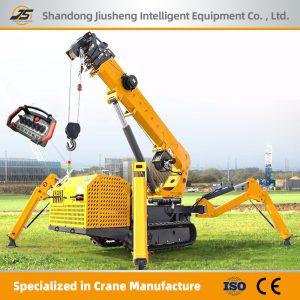
Boom & rotation Multi‑section telescopic booms (4–5 sections) and full 360° slewing give maximum flexibility.
Power source Electric for quiet, zero‑emission indoor work; diesel for outdoor heavy duty; dual‑power for mixed sites.
Access dimensions Widths typically range from 0.6 to 1.6 metres – check doorways, corridors, lifts and scaffolding clearance.
Outrigger footprint “Spider” legs can be independently adjusted for uneven ground, but ensure enough space to fully extend them.
Control system Wireless remote control is standard – it allows the operator to stand at the best vantage point for safety and precision.
Final thought
Choosing the right spider crane is a balance of load charts, site logistics, and supplier reliability. Take the time to map your real‑world requirements, and always test your selection against the load chart with a safety buffer. The right machine will not only get the job done safely—it will also reduce downtime and boost your project efficiency.
 Spider crane,knuckle boom crane,Marine crane