Spider Crane: Definition and Characteristics
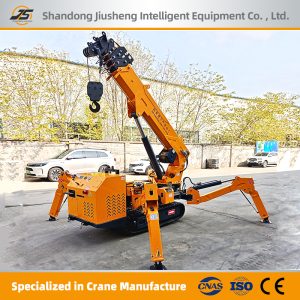
A spider crane is a specialized type of crane known for its compact size and intricate structure, resembling a spider in shape. It typically employs a tracked undercarriage and is equipped with extendable outriggers to enhance stability. Spider cranes are characterized by their high flexibility, efficiency, safety, and ease of maintenance, making them widely applicable in fields such as construction engineering, power industry, equipment installation, petrochemicals, and transportation construction.
I. Definition and Characteristics
- Definition: A spider crane is a unique type of crane with a small, compact form factor and a tracked undercarriage. Its four outriggers can be extended to stabilize the machine body.
- Characteristics:
- Compact Structure: Spider cranes have a small footprint and excellent maneuverability, enabling them to adapt to various working environments.
- High Flexibility: They can operate in confined spaces, achieving precise positioning and handling.
- High Efficiency: Spider cranes can perform close-range operations, avoiding the cumbersome procedures associated with large cranes and enabling rapid and accurate completion of various lifting tasks.
- Enhanced Safety: Equipped with highly automated control systems, spider cranes support remote control operation, effectively reducing the risk of operator errors and accidents.
- Easy Maintenance: Their simple structure makes spider cranes easy to maintain and repair, saving significant maintenance costs.
II. Performance Advantages
- Adaptability to Complex Environments: The tracked undercarriage and extendable outriggers of spider cranes enable them to operate efficiently in rugged terrains such as mountains, muddy roads, and narrow alleys.
- Strong Confined Space Operation Capability: Due to their compact size, spider cranes can easily access narrow city streets, high-rise building interiors, and factory corners, meeting special operational requirements.
- Flexible Boom: The boom of a spider crane can rotate 360 degrees and can be folded for storage. When extended, it can reach a maximum length of 8-15 meters and a lifting height of 6-12 meters, satisfying low-altitude lifting needs for 3-4 story buildings. Some models also feature a “downward lifting” function, enabling operations in basements and deep pits.
- High Maneuverability: The maximum span of the outriggers on a spider crane can reach 5.6 meters, allowing it to maneuver flexibly in confined spaces when retracted. Its tracked undercarriage, combined with the stability of a truck-mounted crane, enables it to operate on slopes and in muddy areas where large cranes cannot access. Some models support both oil and electric power, offering environmental friendliness and fuel efficiency.
III. Application Fields
- Construction Engineering: Spider cranes are used in projects such as glass curtain wall installation, steel structure engineering, and high-altitude lifting, significantly improving construction efficiency and quality. They can also enter indoor and confined spaces for lifting operations, such as handling construction materials and installing indoor equipment.
- Power Industry: The rubber-tracked undercarriage of spider cranes allows them to overcome complex terrain, making them ideal for installing, inspecting, and repairing generator sets, transformers, electrical cabinets, utility poles, and outdoor photovoltaic power generation facilities in the power industry.
- Equipment Installation: Spider cranes can easily access narrow spaces and low-ceiling factories for equipment relocation, installation, and maintenance, avoiding the need for large cranes that may damage external structures, thereby saving costs and improving efficiency.
- Petrochemical Industry: In the petrochemical industry, spider cranes are used for the installation and repair of various equipment, such as reactors and pressure vessels.
- Transportation Construction: In transportation construction, spider cranes are employed for the construction and maintenance of subway tunnels, bridges, railways, and culverts, enhancing construction quality and safety.
 Spider crane,knuckle boom crane,Marine crane