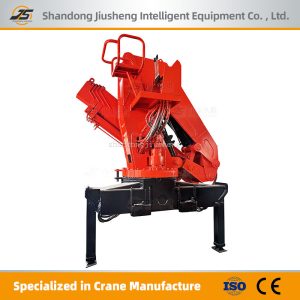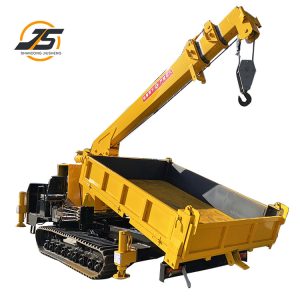
Cost-effectiveness: One of the most significant advantages of a forklift tail crane is its economical nature. Instead of purchasing or renting expensive dedicated cranes or hoists to supplement their forklift fleet, businesses can simply add a jib attachment to an existing forklift. The initial investment for a forklift jib attachment is substantially lower than that of a standalone mobile crane or an overhead crane system.
Enhanced mobility and maneuverability: Unlike conventional truck-mounted cranes (随车吊), which have larger overall dimensions and turning radii, a forklift tail crane retains the compact size and agile handling of the forklift. This enables the equipment to pass through most factory and warehouse doorways, operate in low-clearance spaces, and navigate narrow aisles with ease. This maneuverability makes it particularly valuable for indoor operations and confined job sites.
360-Degree rotational capability: Many forklift tail crane models are equipped with a full 360-degree slewing mechanism, allowing the operator to rotate the boom and hook in any direction without repositioning the entire vehicle. This feature dramatically expands the working envelope and reduces the need for frequent repositioning, saving significant time during repetitive lifting tasks.
Space efficiency and reach: With a telescopic boom that can extend to significant lengths, forklift tail cranes can access hard-to-reach areas that would otherwise require scaffolding, ladders, or manual rigging. Some models can extend to heights of 9-12 meters and horizontal reaches of 7-15 meters, all while operating in spaces where traditional cranes cannot fit.
Energy efficiency and reduced consumption: In configurations where the tail crane assembly is detachable, the forklift can be used in its standard mode when lifting is not required. This avoids unnecessary energy consumption and prevents the crane attachment from interfering with normal forklift operations.
Improved stability: Modern forklift tail crane designs often incorporate the crane mechanism as a replacement for the original counterweight. The forks themselves can also be loaded with materials to serve as an on-demand counterweight, enhancing stability during heavy lifts while eliminating the need to purchase separate counterweight blocks.
Single-operator functionality: Most forklift tail crane systems can be operated entirely by one person, either through the forklift’s existing controls or via wireless remote control. This reduces labor costs compared to operations requiring both a forklift driver and a dedicated crane operator or rigging crew.
Versatile load handling: Unlike standard forklifts which can only lift palletized loads from below, a tail crane can lift suspended loads via a hook, making it suitable for irregularly shaped, oversized, or non-palletized items such as machinery components, steel beams, pipes, drums, and vehicle engines.
Minimal installation time: Fork-mounted jib attachments can be installed in minutes by sliding them onto the forklift’s forks and securing them with safety chains and locking pins, requiring no specialized tools or permanent modifications to the host vehicle.
Introduction
In modern material handling and logistics operations, versatility and efficiency are critical factors in selecting equipment. Among the innovative solutions that have emerged in re...
In the field of material handling and light construction, light-duty cranes have emerged as indispensable equipment, renowned for their flexibility, efficiency, and cost-effectiveness. Unlike heav...
In the international market, compared to traditional cranes, customers pay more attention to the five core advantages of mini crawler spider crane in terms of adaptability in narrow spaces, high-p...